

OUR DIVESITES

How we choose our dive sites for the day
Guests often ask when we visit which dive site, or if they can book a trip to a certain dive spot. While we do have a total of 20 dive sites, with 5 of them being shore locations and 15 being boat dives sites, we can't ever promise or predict a specific dive site.
In the Mediterranean Sea, the weather changes a lot and it's not as predictable as it is in places that offer a set dive site schedule. Therefore we always make a weather assessment in the morning so we can ensure good and safe conditions for our guests and crew. We are always happy to hear your wishes though and try to fulfill them whenever possible!
Shinaria
The chances are quite high that if you have been diving with Dive2gether, you have spent a lovely time at Shinaria Beach.
The bay is protected from the common north wind and offers plenty of variety to spend multiple days of diving. Whether you are snorkelling, taking your first breaths underwater, completing training dives from the various sand patches at different depths or admiring the huge canyons and the drop-off, this dive site offers something for everyone. When weather conditions allow for it, experienced divers can visit a beautiful cavern. Almost any fish family can be spotted in Shinaria, with our favorites being the cute curious puffer fish that can always be found searching the sand for food.
Maximum depth: 27 meters
Facilities: beach beds (paid), showers, toilets, taverns, and tight parking space

Souda
This widespread beach is sheltered from west movement in the water and is believed to match a certain place called Foinikas described in the Old Testament. Curious? You can visit the old ruins that lay land inward surrounded by palm trees (which are called Foinikas in Greek)!
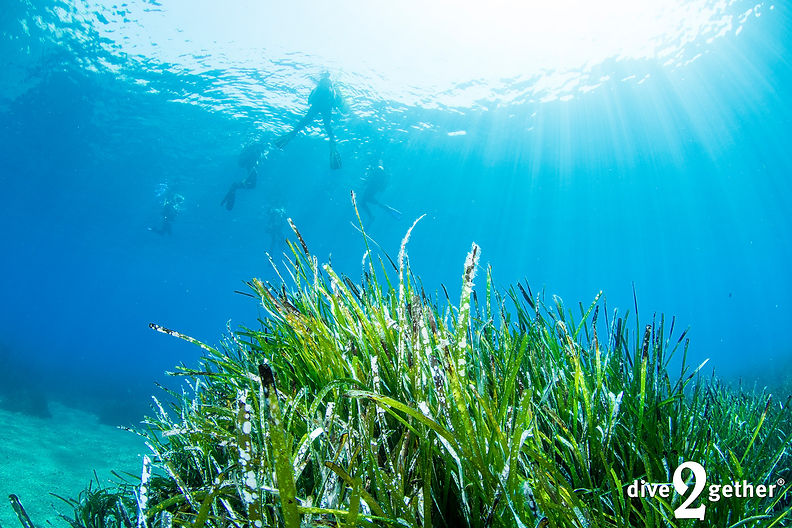
Although most of the bay is a slowly descending sandy area, we find different rock formations on both sides of the bay. There are large sea grass meadows & sea grass walls. Here we have started some sea grass mats where we conduct research and plant new Posidonia fragments. You can even join our seagrass reforestation efforts in our marine biology activites! This dive site is excellent for spotting different species of marine life and it’s possible to find some of the rarer sights such as the seahorse, the broad nosed pipefish or a sting ray. At night you'll encounter octopus, sepia or moray eels hunting for their dinner.
Maximum depth: 10 meters
Facilities: Beach beds (paid), showers, toilets, beach bar, tavern, dressing room and lots of parking space
Ammoudi
Ammoudi is Greek for Sandy beach, so no surprise you’ll find plenty of Ammoudis around the country. There is a diversity of sandy areas, rock formations with some beautiful cracks in the wall and patches of sea grass. A beautiful feature is the sunshine cavern which gets its name from the curtain of light that shines right into the opening on the surface.
Apart from the common life to be expected on any shore dive site, sometimes European squids can be seen in the bay. The shallow rock plateau in the middle of the bay is very popular for larger blennies as well as small scorpion fishes.
In your lunch break you can find the best pita kebab in the local Kantina! Ammoudi is often visited during days with strong north wind and is popular for night diving as well.
Maximum depth: 9 meters
Facilities: Beach beds (paid), showers, toilets at the camp site, cantina and lots of parking space


Damnoni Old Harbor
The Old Harbour was once used for shipping supplies during the time before roads were built through the gorges connecting the north and the south. Nowadays it’s only used by a few fishermen’s boats and the old warehouses were turned into beautiful holiday houses.
This treasure is only available for visits during the low season and offers fantastic diving! Low season comes with colder temperatures which makes it a perfect time of year to spot Spanish and spiny lobsters.
You’ll see a beautiful landscape in the bay of Damnoni. One of the unique features are limestone plateaus. Divers will enjoy a dive site with lots of diversity, different depths, and incredible canyons further outside the bay.
Maximum depth: 25 meters
Facilities: Fresh water garden hose, lunch drive possible for toilet stops. The parking space is above the harbour
Bali / Karavostasi Beach
Not to be confused with the popular island in Indonesia, Crete has its very own Bali! This dive site is located a 1-hour drive away from Plakias, on the north coast of the island. Due to the longer drive and therefore extended day program, Bali is visited when diving is not possible on the South coast. But it’s definitely not a bad place for a plan B!
The lovely little bay is a playground made for divers. The fish behave a little differently as they expect you to give them a snack (don‘t ever feed wildlife though!), there are artificial reefs built and you might even come across a fixed underwater camera filming you as you go via a livestream. Even more reason to look streamlined and have perfect buoyancy! It’s a fun experience to dive this place that offers something for every skill level!
Maximum depth: 20 meters
Facilities: Beach beds, showers, toilets, tavern and limited parking space.


Duck Rock
Although Duck Rock is just a small rock shaped like a rubber duck, the dive site below is huge and very interesting. Descend along the mooring line and you’ll be directly at 12 meters of depth from where you can follow a wall on your left side to visit the entrance of a cave. This cave is too narrow to enter but you’ll see lots of life around the entry and exit locations. From here you can visit a big overhang at around 25 meters or make your way back through a gorge. Depending on the route you can either follow the wall on the open seaside at a depth of around 12-14 meters or turn around on the plateau that will bring you gradually up to safety stop levels. On your way back to the boat there is another crack you pass where you can find some nudibranchs.
Maximum depth: 30+ meters
Safety stop: Enjoy the shallow waters and beautiful sunlight around Duck Rock and swim the last minute towards the boat
Black Rock
Black Rock is probably one of the most visited boat dive sites in our selection, as it offers something for all and never disappoints. The rock looks a bit like the tip of an iceberg. There’s a large reef at 3-7 meters depth, then the rock makes a steep drop to about 26 meters on the south side. The deeper area is great for spotting bigger groupers and lionfish.
A few lost fishing lines are re-used and tied down to the bottom with a buoy just below the surface. Be sure to spend some time here as they are completely overgrown with molluscs, feather star fish and hydro polyps which attract flabellinas to the area as well. Follow the rock formation and you end up in a beautiful, large canyon with some cracks where lots of cardinal fish like to hide. Near the end of the gorge is always a great opportunity to check for large scorpion fish or moray eels. After the gorge you can head in the right direction back to the boat and enjoy a safety stop on the shallow reef.
Maximum depth: 26 meters (when leaving the wall, deeper is possible)
Safety stop: Hang around the reef at 3-7 meters

Willy's Wall
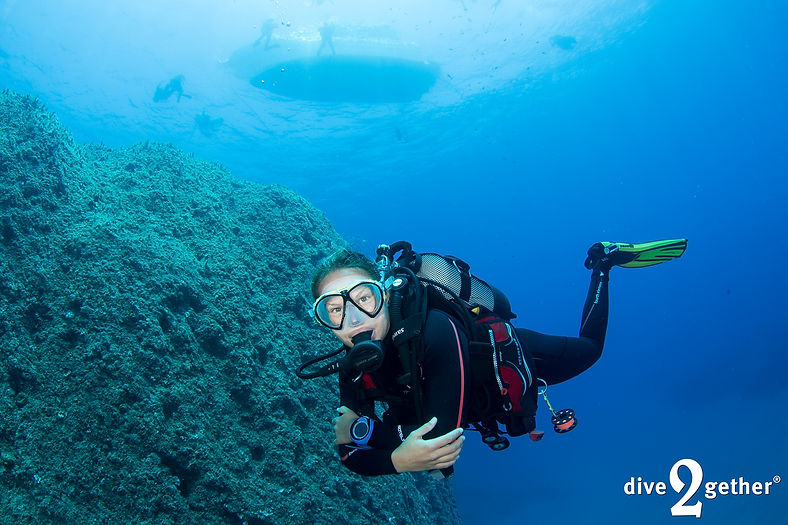
Dedicated to Willem, the (Dutch) owner of a dive shop on Ammoudi beach who discovered this dive site first. It’s a reef that is laying at least 6 meters below the surface with a sloping bottom on one side and a beautiful straight wall on the other side, covered with holes and overgrown with life. Take a torch with you and cover all spots one by one to find the most life. Sometimes on the bottom we can find big scorpion fish or groupers hiding underneath. This natural reef attracts lots of groups of fish such as the damsel fish that enjoy the view from above. Also quite particular are the ornate wrasses that are active (especially) here during the early summer months when it’s mating time. A typical dive here consists of a part following the wall and a shallower swim back on top of the wall. As the dive site offers plenty of diversity and all kinds of different marine life, we like to say: willy’s wall has got it all!
Maximum depth: 26 meters
Safety stop: Just above the reef together with large groups of damsel fish
Eye of the Tiger
Even though this dive site is very close to our neighbouring site Duck Rock, the bottom type here is completely different. Between the large rock structures, the bottom is covered in small sharp rocks. Sheltered during strong north wind days, Eye of the Tiger is a place to seek calm waters. It lays in a shallow bay, but that is not where it stops.
Following the rocky bottom to the south you’ll stumble on a huge rock formation that has 10 meters on top and is deeper than 40 meters on the deep end. On both sides of the large formation, you’ll find plateaus on different depths that continue like a staircase to the next deeper level. You can make your safety stop relaxing in the shallow waters with beautiful sunlight shining through. Adventurous divers can enter a small cave below the surface and ascend to the surface inside.
Maximum depth: 30+ meters
Safety stop: Enjoy the shallow bay while the minutes tick away


Turkish Delight
Turkish Delight offers perfect shelter from north wind and while big waves can be spotted on sea, this bay has tranquil and light blue waters. There are two routes to follow when diving here, depending on the maximum depth of the group. More advanced divers can enter a large cave, while others can dive along the wall above it. Both will not be disappointed with the huge amounts of Sunset Cup Corals that like to live in the shade. Following the wall, you’ll eventually see a U-turn coming up with a natural spiral staircase bringing you to the plateau above the wall. In case any divers visited the cave, you’ll experience a nice little bubble bath with air leftovers that comes up through tiny channels in the ceiling of the cave. The bay is perfect to spend some time in the shallow to decompress before making your way back to the boat.
Maximum depth: 26 meters (30 meters when leaving the wall)
Safety stop: Enjoy the shallow bay while the minutes tick away
Paligremnos Wall
Paligremnos Wall can be seen from all over Plakias and is the tip of the bay on the left side. All over Paligremnos mountain you’ll find steep, smooth walls and the same goes for this dive site. From the boat’s mooring spot, you can dive in the west direction following the deeper side of the wall. You might already spot your first flabellinas, but if not here, then surely on the way back at the plateau that looks like a balcony above the deeper area. Flabellinas feed on hydro polyps, which look like little dead trees and are very abundant here. You’ll want to bring your macro camera for this dive! Apart from our favorite bright pink nudibranchs, it’s not uncommon to find the greek sea goddess, one of the larger nudibranchs in the Mediterranean Sea.
Maximum depth: 26 meters
Safety stop: Stay close to the wall during the safety stop and swim the last minute towards the boat


Souda Rock
Way back when Dive2gether was a friction of the size it is now, the Koblens family and their team where diving from Souda Bay. Always looking out to sea, they noticed some rocks sticking out of the water. Paul knew that one day he was going to buy a boat and expected this to be an amazing dive site. And he was right! Souda Rock is sheltered from west movement and only a short drive from the harbour and became Dive2gether’s first boat dive site. The dive site actually contains multiple rocks. And is a real diver’s playground with fun canyons to swim through on a shallow depth. On this dive site there is no need to make a safety stop under the boat, but hang around the reef and spot the high density of feather star fish while waiting for the 3 minutes to pass. More advanced divers can visit the so-called Moray Eel Rock which is always a great place to visit as it’s likely to spot a moray eel.
Maximum depth: 27 meters at Moray Eel Rock
Safety stop: Hang around the reef on 5 meter and use the last minute to swim to the boat
Dragon's Nose
Look out from the bay of Plakias and you might understand why this rock structure is referred to as the sleeping dragon of Plakias. Underwater the formation continues and gives the impression that the Dragon is sticking out its tongue. Here we find a bay that’s naturally sheltered from west wind, which is rare on the entire south coast of Crete.
The bay is a little shallower, but you can follow the "tongue" of the dragon to get to slightly deeper waters. When you cross the tongue, you might come across a particular crack which is great for spotting groups of cardinal and squirrel fish. Down here you reach the deepest point of the dive, you can keep the wall on your right and if time allows, pay a visit to the narrow pink cave, or the nostril of the dragon if we stick to the story. It’s overgrown in pink algae and there is a beautiful curtain of light shining in from an opening on the surface.
Maximum depth: 20 meters
Safety stop: Swimming from the tongue to the boat or before entering the pink cave
Dragon's Nose II
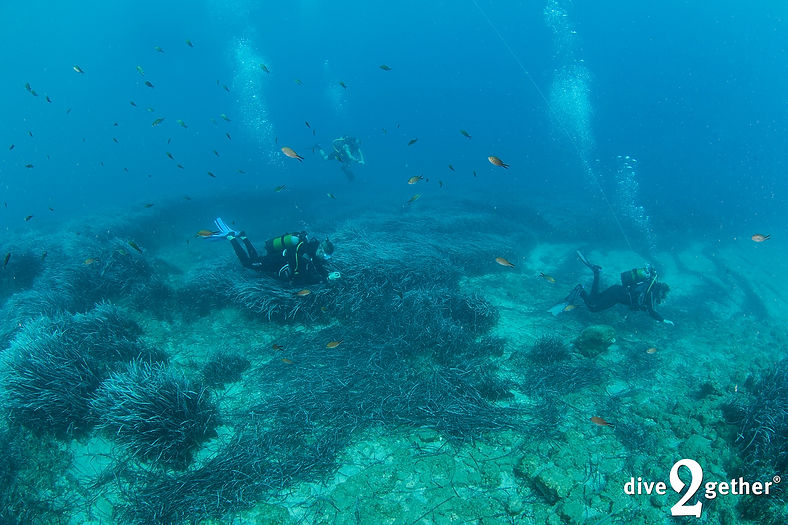
When visiting Dragon’s Nose, visiting its deeper brother Dragon’s Nose II is an excellent alternative to avoid making the same dive twice. To experience Dragon’s Nose II to the fullest, we recommend swimming out from the boat and descending on the south side of the ”tongue”. Here you can find a big deeper rock that’s often surrounded by large schools of picarels and the rocks and walls have lots of holes where marine life is hiding. It’s a great place to spot nudibranchs and moray eels. Just don’t get too distracted by all the cool life and remember to watch your deco time and air supply!
Maximum depth: 27 meters
Safety stop: Swimming from the tongue to the boat
Doggy Rock Bay
It’s debatable if this rock structure looks like the name it’s been given, but when you dive here you never know what you are going to get. Because of the many different levels and proximity to the open sea, you can be surprised with big fishes or even rays passing by. When keeping your eyes on the wall, you’ll find many feathered starfish, large spined sea urchins and divers with an eye for details can spot nudibranchs as well. The highlight of this dive site is the view to the deep drop that goes down way deeper than recreational divers can visit. On the way back you can follow the wall at any preferred depth and even spend some shallow time in the little bay which is an overgrown, rocky area, where a beautiful and large spiral tube worm lives.
Maximum depth: 30+ meters
Safety stop: Enjoy the shallow bay while the minutes tick away

Doggy Rock Drop
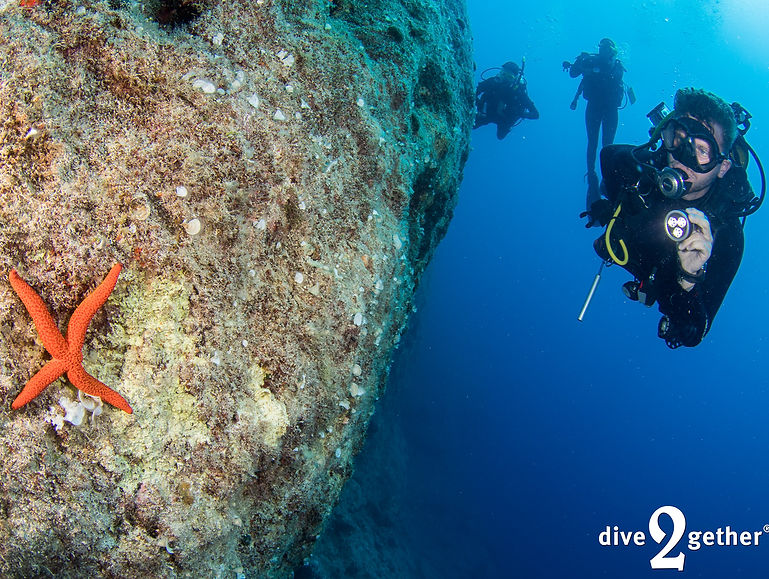
Being the neighbour of the dive site Doggy Rock Bay, this dive site is located a little closer to the big drop and sheltered from strong north wind. On days with strong wind, it might look very calm here, but don’t be fooled by it. You can be surprised with an underwater current in an opposite direction as you would expect, so plan your dive here with caution. The scenery on this dive site is magnificent and has something from the scenes of a Lord of the Rings movie. Don’t forget to also peek away from the wall every now and then, you might be surprised by big hunting fish coming by, such as the dentex or one of the larger groupers. Advanced divers can dive under the big overhang that peeks over the deep drop which is shared by the neighbour dive site. Afterwards there is a pathway leading you back to the plateau where a few rock formations give you a pleasant time swimming back to the boat.
Maximum Depth: 30+ meters
Safety stop: Hanging under the boat
Grand Gate
Grand Gate got its name from looking like a big arch above the surface, which continues underwater and is a large gateway to swim through. The boat is moored in front of the little bay above the 17-meters-deep bottom. From here you can make your way to the tunnel, either spend some time first at the outside wall, or dive directly through it. The gate is big enough for all divers to go in simultaneously and when entering, the exit on the other side is already visible. This creates an awesome view to see the sunlight hitting from the other side. On both sides of the arch there is a playground for divers. Lots of boulders that must have fallen from the high shoreline create little swim throughs and overhangs. In the bay on the east side, you can find lots of sessile animals making this site a great one for our Hidden in Plain Sight marine biology activity.
Maximum depth: 19 meters
Safety stop: Swim at 5 meters depth from the bay towards the boat and finish the stop there


Fisherman's Friend
This is the dive site with the longest boat drive required to get there. It got its name because the area is popular for fishing as it’s close to the deep sea and we often find fishing nets around this place. Keep your eyes on the horizon when relaxing on the boat, it’s not uncommon for larger marine animals to come to the surface here, far away from land. Once descending to the 15-meter-deep plateau, you can start an excellent dive along the drop-off. Take a torch with you to check out the abundance of marine life hiding in the cracks and overhangs. In the east direction from the boat is a gorge-like structure, go past this gorge and you can find an elephant ear sponge, one of the biggest to be found in the Mediterranean Sea. When diving along the drop-off, keep an eye out for the deep blue as we have had quite a few sightings of sting rays and bigger groupers in this area.
Maximum depth: 40+ meters
Safety stop: Hanging under the boat. Keep an eye out so you don’t drift away!
Papadoplaka
The latest addition to the Dive2gether dive sites and not entirely explored yet is Papadoplaka. Papadoplaka is Greek for “the priest rock”, which was given to this rock because it lies just one meter below the surface, making it a dangerous spot for boat traffic even though it’s a lovely place to dive. There’s a rumour that in the past a boat failed to avoid this holy plateau and sunk. Although we have looked for it, we were not able to find any pieces of a shipwreck but fell in love with this lovely dive site. With the bottom too deep to make a mooring, visiting this dive site is only possible with a free drifting boat. You can gear up at the mooring of the Grand gate, taxi to the dive site and start at the big boulder where you’ll be accompanied by lots of damsel fish. Not many have dived this place so if you go here, you’ll be among the few explorers of Papadoplaka.
Maximum depth: 19 meters
Safety stop: Follow the wall on 5 meter and swim in mid water to the boat


Elephant Rock
Similar to Dragons Nose II, this dive site is sharing its mooring line with the neighbour dive site, in this case the one from Paligremnos Wall. If you are not sure why this place is called Elephant Rock, ask your captain to make a drive by and point it out to you. You don’t need too much imagination to recognize an elephant shape including an eye and the trunk going underwater and sticking out again, like the elephant is ready for a few splashes. The main feature to this dive site is the spacious cavern that can be found when following the wall. After spending some time here, you might want to go even further and spot some old rails that were part of a brown coal mining project dating many years back. Just like many places it’s common to come across Lionfish here, but be careful as they seem to be a little cheekier in this area compared to other dive sites.
Maximum depth: 19 meters
Safety stop: Stay close to the wall for some time at 5 meters and swim the last minute of your stop towards the boat
Share Your Memories
Which of these is your favorite dive site? We'd love to hear about your favorite memories you made diving here!
Wow I have so many nice memories! But I think my all time favourite diving site has to be Paligremnos wall. I just love the pink nudibranchs I have seen there and made beautiful macro pics!
Van alle duikstekken is Shinaria de stek waar ik de meeste en mooiste herinneringen aan heb. Deze duikstek is zo veelzijdig dat ik altijd weer iets nieuws ontdek. De bootduikstekken zijn ook gaaf. Souda Rock, Dragon's Nose (pink cafe!), Willy's Wall en Black Rock hoop ik dit jaar te bezoeken!