
Seagrass Restoration: How it works and how you can participate

Why should we even care about seagrass?
We all know that we need to protect our forests because they are providing us with precious oxygen. But few of us know that forests are only part of the story. 70-80 % of the earth’s oxygen actually comes from the sea – It’s phytoplankton, algae and seagrass that produce most of our oxygen.
Besides producing important oxygen, seagrass meadows also store carbon dioxide in their biomass and sediments, contributing to our fight against climate change.
But that’s not all! Seagrass meadows are biodiversity hotspots as they provide food and shelter for many marine species, they protect our coasts by buffering waves and reducing erosion and they filter the water – which gives us amazing visibility for diving!
Unfortunately, climate change and human influence negatively impact our underwater world just as much as our forests. Especially seagrass is vulnerable as it is highly sensitive to environmental changes and species like Posidonia oceanica grow very slowly, only about 2 centimeters per year, and can take decades to recover once damaged.
But what can we do to protect seagrass meadows?
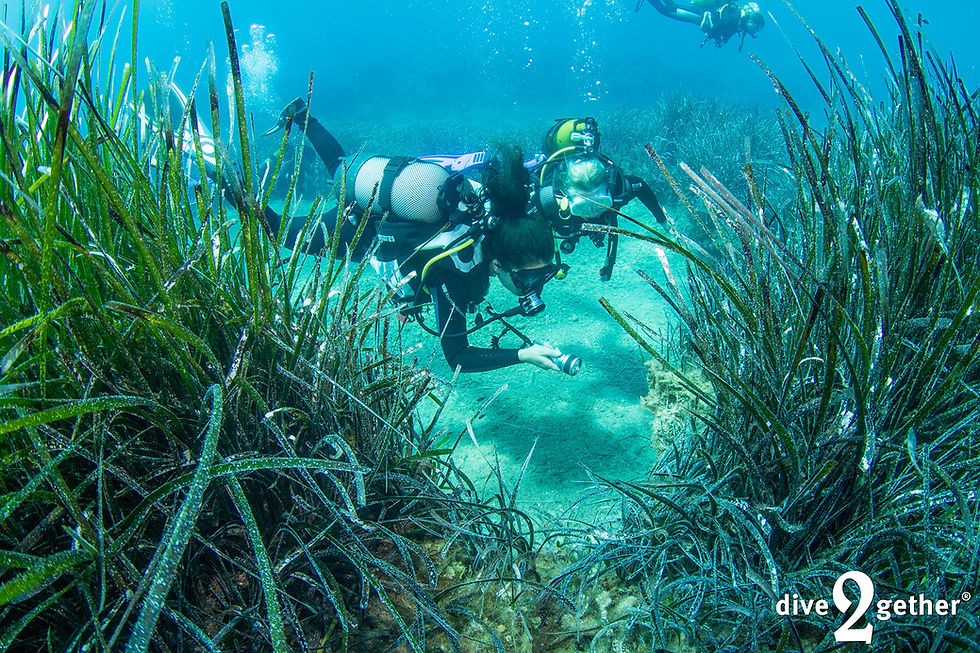
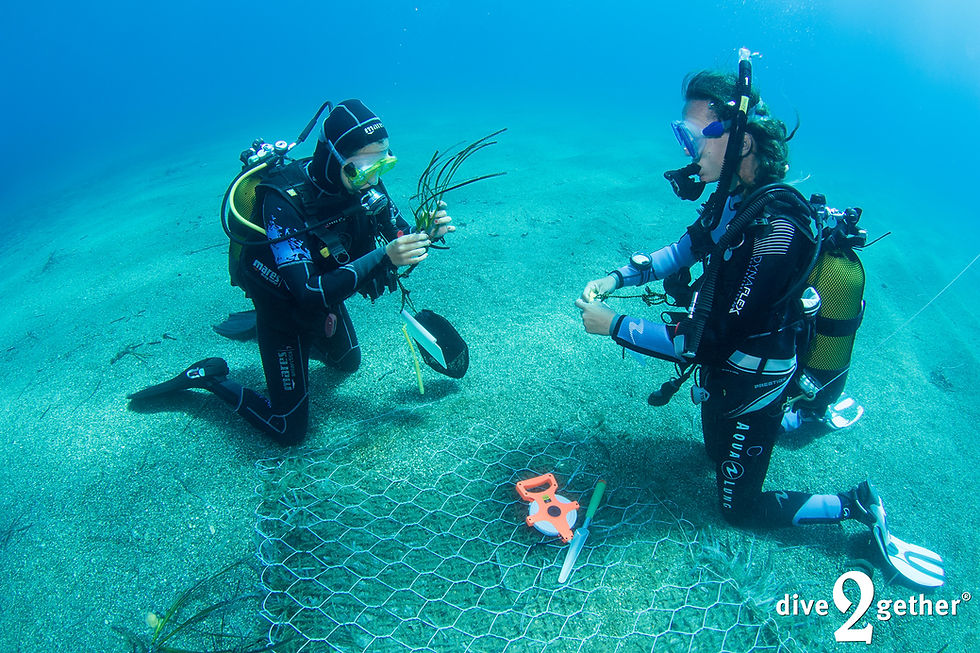
This is where our field station comes in: In 2022 we started a restoration project for our local Neptune grass meadows (Posidonia oceanica). By installing geo-mats in degraded seagrass areas, we created a good foundation where uprooted seagrass fragments can reattach and grow again. Since we started the project, we have planted over 700 fragments. Our in-house marine biologists regularly monitor the growth and health of our fragments and are happy to report that this project is a huge success with fragments either keeping or improving their health status.
So how can you participate?
We offer a special marine biology activity where certified divers get to spend a whole day with one of our marine biologists. No previous experience or knowledge required! You will receive an extensive briefing to learn techniques for identifying the marine life inhabiting our endemic Posidonia oceanica meadows and then gear up for your two dives. You’ll learn how to measure shoot density using a square, make health assessments, and then even plant your own seagrass fragments in one of our special geo-mats. Back at the dive school, you will peer through our microscopes to meet some of the tiny epibionts that make up such a big part of the biodiversity of these seagrass meadows.
By joining our marine biologists on this day, you are actively contributing to important research and the future health of the Mediterranean Sea's most important habitat, all according to our motto: Dive, Learn, Care – Together!

If you are ready to dive right in and do your part in protecting our precious seagrass, book your marine biology activity here.


Comments